
Portable FT-IR spectroscopy
Fourier Transform Infrared spectroscopy (FT-IR) is a technique that makes it possible to identify a wide range of organic (binders, paints, adhesives, etc.) and inorganic compounds (pigments, salts, degradation products, etc.) through the analysis of their functional and molecular groups. It is widely used to characterize the components of an artifact, as well as to identify the materials used for conservation purposes and their alteration products. FT-IR also provides useful information for an assessment of the conservation status of the work under investigation.
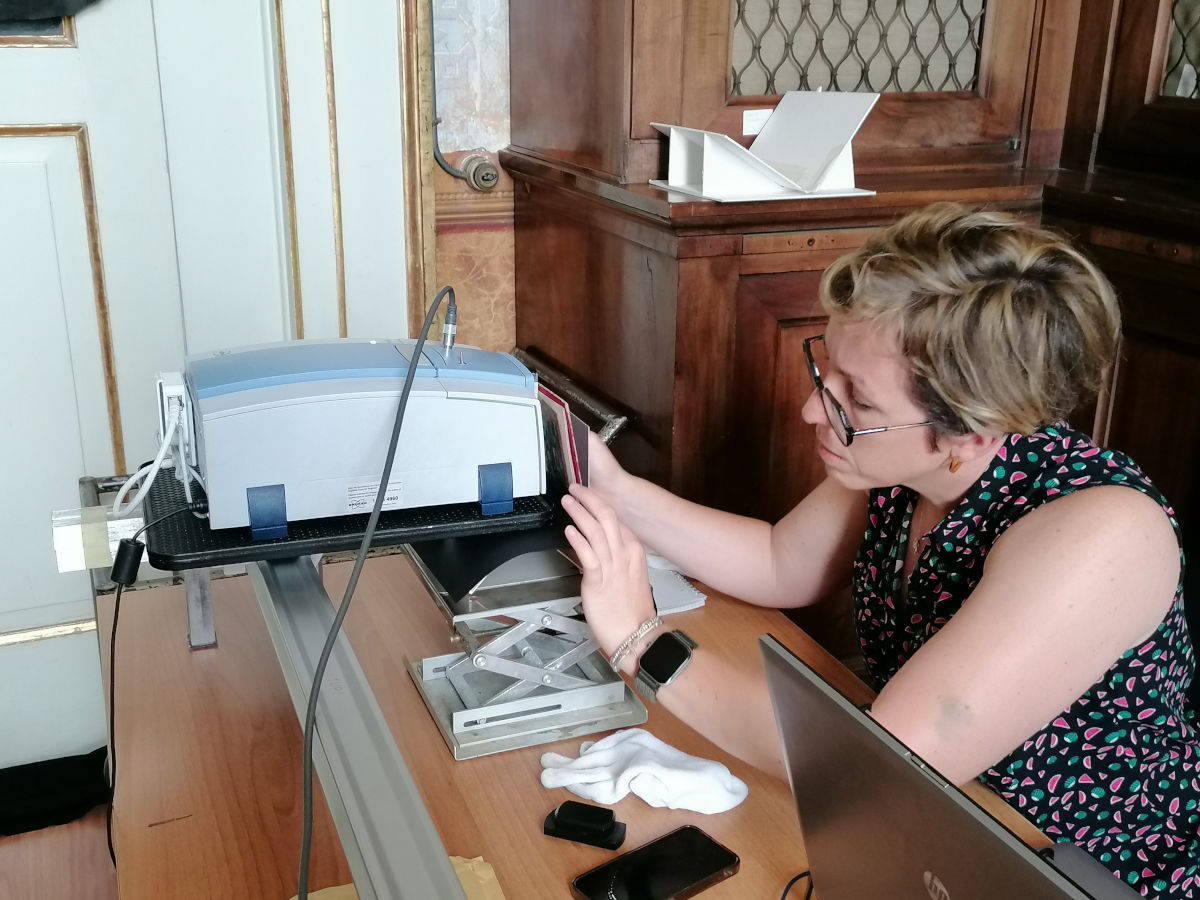
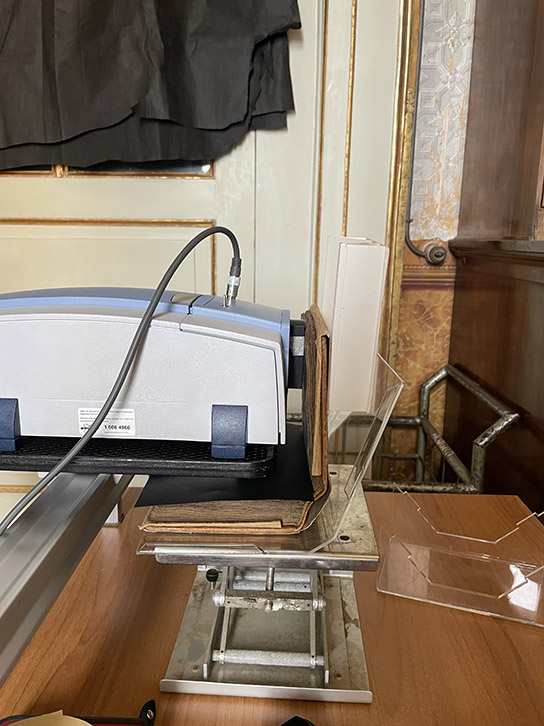
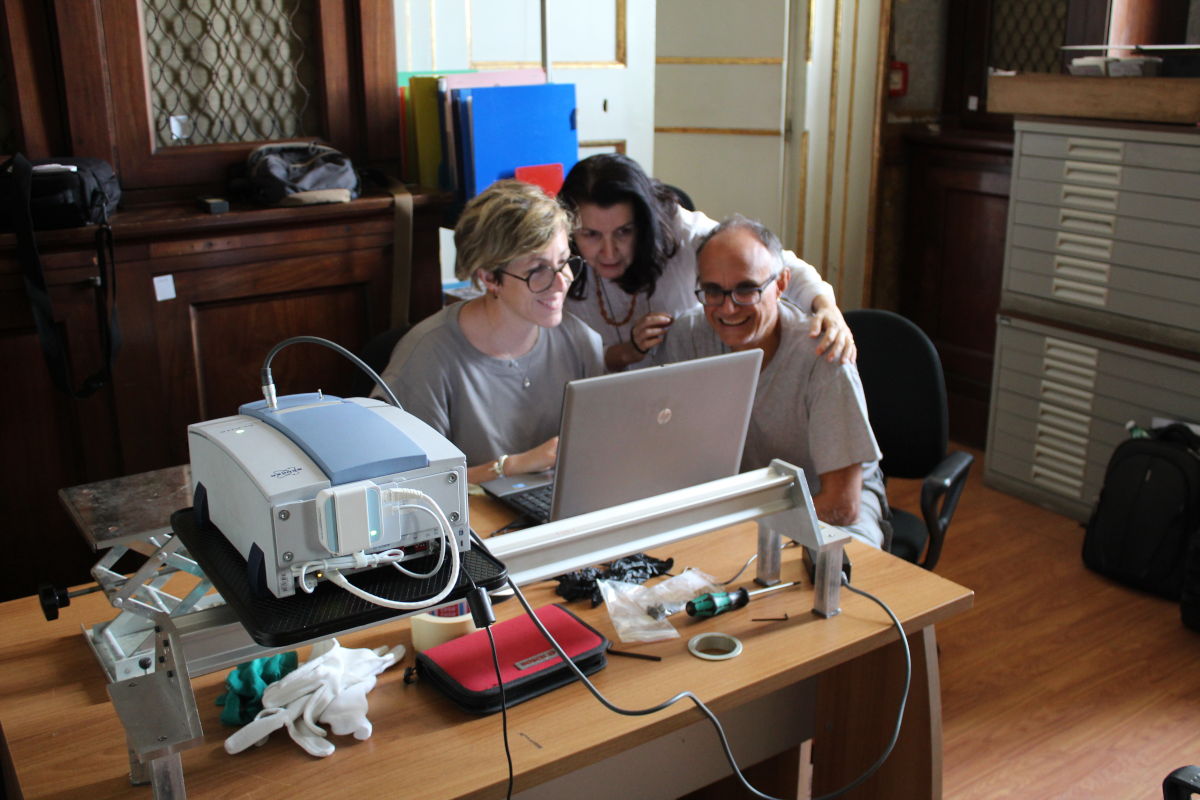
In the framework of the present study, a portable Bruker Optics Alpha FT-IR spectrometer from the CNR-IFAC SABeC laboratories was used. It acquires spectra in total reflectance mode in a non-invasive way. The spectrometer consists of a globar-type infrared source (silicon carbide with emission comparable to that of a black body at a temperature of approximately 1000 K), an interferometer and a DTGS (deuterated triglycine sulfate) pyroelectric detector, with a resolution of 4 cm-1 and sensitivity in the 7500–375 cm-1 spectral range, comprising the entire mid-infrared region (MIR, 4000–400 cm-1), as well as part of the near-infrared (NIR, 7500–4000 cm-1) and of the far-infrared (FIR, 400–375 cm-1). EZ OMNIC 7.3 and Spectragryph 1.2 software were used for data processing. The identification of the materials was carried out by comparison with reference spectra found in literature databases or acquired at the CNR-IFAC laboratories.
The spectrometer is also equipped with different plug-and-play modules for collecting spectra in transmittance and Attenuated Total Reflectance (ATR) modes. The compact design of the spectrometer makes it possible to successfully work in situ.
 |
 |
 |
|
|
CNR-IFAC Bruker Optics Alpha FT-IR spectrometer setup at the Biblioteca Nazionale Vittorio Emanuele III of Naples. |
|
References
- Aceto, M., Agostino, A., Fenoglio, G., Gulmini, M., Bianco, V. and Pellizzi, E., 2012. Non invasive analysis of miniature paintings: proposal for an analytical protocol. Spectrochimica Acta Part A: Molecular and Biomolecular Spectroscopy, 91, pp.352-359.
- Bartolozzi, G., Picollo, M., Marchiafava, V., Centeno, S.A., Duvernois, I., Di Girolamo, F., Modugno, F., La Nasa, J., Colombini, M.P. and Rava, A., 2016. Anselm Kiefer: a study of his artistic materials. Archaeological and Anthropological Sciences, 8, pp.563-574.
- Carlesi, S., Bartolozzi, G., Cucci, C., Marchiafava, V. and Picollo, M., 2013. The artists' materials of Fernando Melani: a precursor of the Poor Art artistic movement in Italy. Spectrochimica Acta Part A: Molecular and Biomolecular Spectroscopy, 104, pp.527-537.
- Cucci, C., Bartolozzi, G., Marchiafava, V., Picollo, M. and Richardson, E., 2016. Study of semi-synthetic plastic objects of historic interest using non-invasive total reflectance FT-IR. Microchemical Journal, 124, pp.889-897.
Keywords: Portable FT-IR spectroscopy