
Biblioteca Queriniana – Brescia
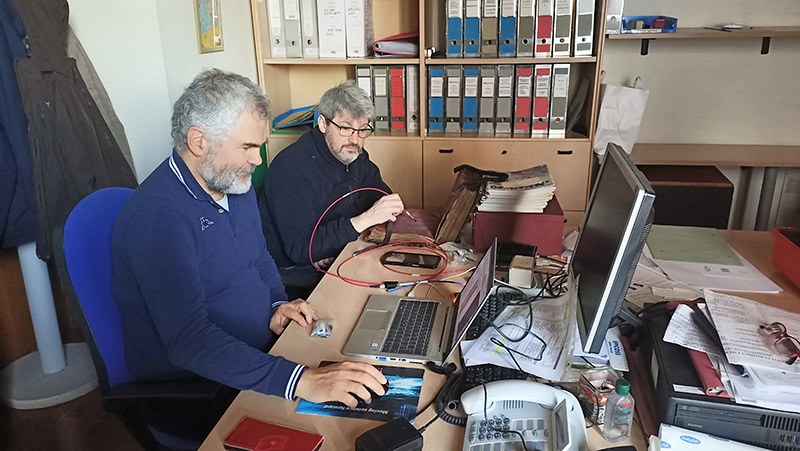
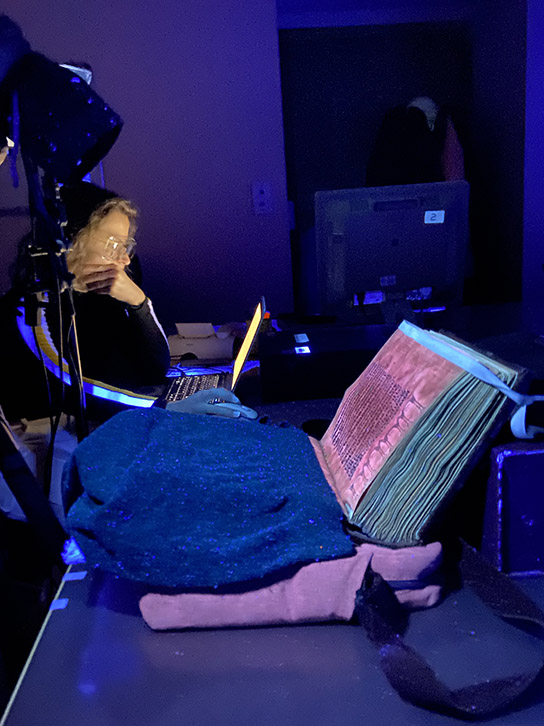
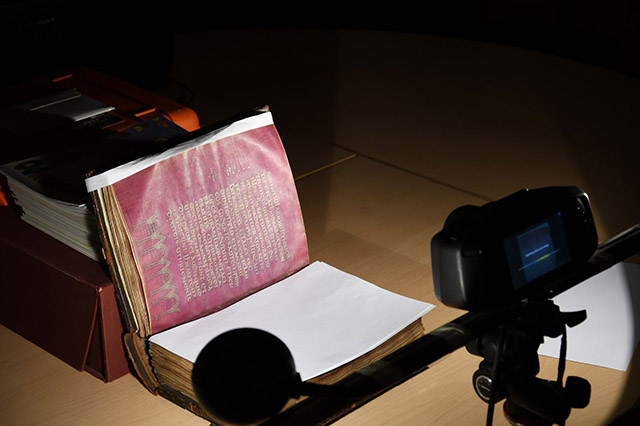
The analytical investigation carried out at the Biblioteca Queriniana in Brescia focused on the characterization of the Codex Brixianus, a 6th-century Latin Gospel book that was probably produced in Italy. The study was carried out via FORS, portable X-ray fluorescence spectrometry (p-XRF), as well as multiband and hyperspectral imaging techniques, in order to identify the materials used, understand the manufacturing techniques and assess its current state of conservation.
 |
 |
 |
|
|
FORS, hyperspectral imaging and UVL setup. |
|
The purple dyeing of the parchment clearly differs from what was observed in the other codices investigated in the framework of the PURPLE project. While FORS identified a mixture of orchil and indigo/woad in the first section (the Canons), the investigation of the second section (the Gospels) revealed a more peculiar use of two different dyes, folium and orchil. Hyperspectral imaging was particularly useful, as it made it possible to map the distribution of the different dyes, even on the same page. Such a distribution of different dyes on a single page is rather uncommon in the context of purple codices, and further investigations could be useful to verify whether the same technique was used in its twin codex, the Codex Argenteus at the Uppsala University Library.
Significant differences in the chemical composition of the inks used in the two sections of the Codex Brixianus were also observed. Concerning the silver inks, higher amounts of silver, gold, copper and lead were detected in the Gospels section, while Fe-rich silver inks were detected in the Canons section. On the other hand, the gold inks showed a more homogeneous composition; the higher amounts of sulfur detected in the gold ink of the Gospels section were correlated to the use of different additives during the grinding procedures.
Keywords: Biblioteca Queriniana – Brescia